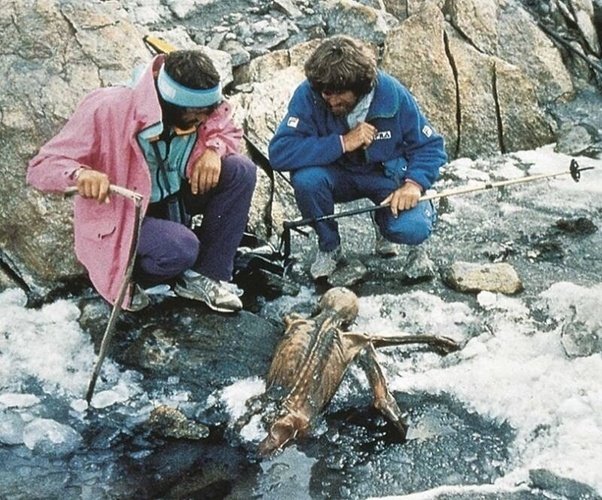
In September 1991, two German hikers stumbled upon the remarkably preserved remains of a murder victim in Austria’s Ötztal Valley region. Today, 31 years later, researchers are still uncovering new insights from this ancient crime scene.
In what was initially thought to be a recent mountaineering accident, the hikers were taken aback to discover that the human remains belonged to a victim of a cold-blooded murder dating back 5,300 years. Named “Ötzi,” this ancient figure has since become one of the most significant archaeological discoveries of all time.
Thanks to the unique preservation conditions provided by the freezing ice of the Austrian glacier, Ötzi’s body has remained astonishingly intact. Even seasoned police detectives, brought in to investigate the ancient crime, were astounded by the level of preservation. One detective remarked, “The body was in better condition than recent homicide victims I’ve worked on who have been found out in the open.”
Over the past three decades, scientists and archaeologists have meticulously studied Ötzi’s remains, learning a wealth of information about the circumstances surrounding his death. Initial examinations indicated that Ötzi was likely a shepherd, approximately 45 years old, and stood at around 5 feet 5 inches (160 cm) tall. The discovery of a stone arrowhead embedded in his left shoulder, along with various other wounds and injuries, led researchers to conclude that he died a violent death, presumably as a result of an ancient altercation.
Moreover, Ötzi’s possessions and equipment, which were discovered alongside his body, have provided invaluable insights into the daily life of a person from the Copper Age. His gear included a remarkable array of tools, such as a well-preserved copper axe, a quiver of arrows, a backpack made from woven grass, and various other artifacts that offer a glimpse into the technology and lifestyle of his time.
The examination of Ötzi’s remains has also provided essential data on ancient medical practices and the state of health during the Copper Age. Researchers have been able to identify several health issues, such as evidence of Lyme disease and joint problems. These discoveries not only shed light on the health challenges faced by individuals in prehistoric times but also offer clues about the medical knowledge and treatments available during that era.
To honor this incredible archaeological find, Ötzi’s body was put on display in Bolzano, Alto Adige province, Italy, close to the village of Velturno where he was initially discovered. This decision was made as Ötzi was found just 100 meters over the Italian border, making it a joint collaboration between Austria and Italy to preserve and showcase this invaluable piece of history.
The continued research into Ötzi’s life and death serves as a testament to the enduring fascination with the mysteries of our past. As technology and scientific methods advance, it is likely that more secrets of this ancient murder and the Copper Age civilization will be unlocked, enabling us to piece together the story of Ötzi and gain a deeper understanding of the distant past. #archeology #ancientmystery #copperage #Ötzi