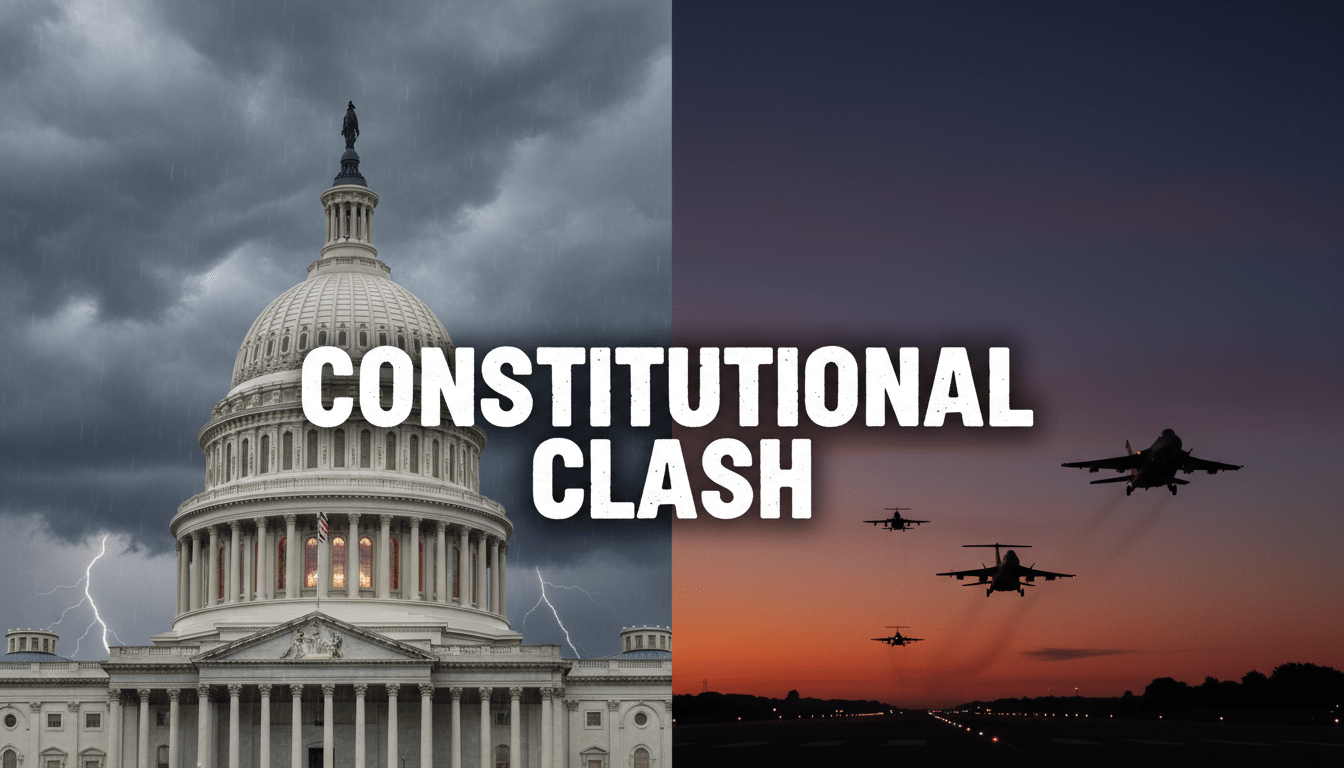
WASHINGTON — President Donald Trump has ordered military strikes against targets abroad without seeking prior authorization from Congress, initiating a sharp constitutional clash that has drawn immediate reaction from Detroit’s congressional representatives and legal scholars.
The White House confirmed the military action late yesterday, citing an “imminent threat” to national security as the justification for bypassing the legislative branch. However, the decision to act unilaterally has reignited a long-standing debate regarding the War Powers Resolution of 1973 and the separation of powers mandated by the Constitution.
In Detroit, the move has been met with concern from local lawmakers who argue that the executive branch is overstepping its authority, potentially drawing the United States into a prolonged conflict without the consent of the people’s elected representatives.
The Constitutional Clash: Executive Authority vs. Congressional Power
The core of the controversy lies in the interpretation of Article I and Article II of the U.S. Constitution. While the President serves as Commander-in-Chief, the Constitution grants Congress the sole power to declare war. As Trump orders strikes without a legislative vote, constitutional law experts in Detroit are analyzing the legal ramifications.
According to legal analysts at Wayne State University Law School, the executive branch often relies on the concept of “anticipatory self-defense” to justify rapid military action. However, critics argue that without clear evidence of an immediate attack on the homeland, such actions violate the War Powers Resolution, which requires the President to notify Congress within 48 hours of committing armed forces to military action.
“The definition of ‘imminent’ has been stretched by multiple administrations, but ordering offensive strikes without consultation creates a dangerous precedent,” noted a senior lecturer in constitutional law at a Detroit-based university. “This isn’t just a political disagreement; it is a fundamental stress test of our checks and balances.”
Detroit Lawmakers Respond to Unilateral Action
Michigan’s congressional delegation, particularly those representing the metro Detroit area, have been vocal in their response. The region, known for its political engagement and diverse population, has often been a center for anti-war advocacy and strict adherence to constitutional processes.
Representative Rashida Tlaib (MI-12), whose district includes parts of Detroit and serves a large constituency sensitive to foreign policy decisions, issued a statement condemning the bypass of Congress. Tlaib emphasized that the power of the purse and the power to declare war belong to the legislative body to prevent unchecked executive overreach.
“The American people have a right to be heard through their representatives before we engage in acts of war,” the statement read. “Unilateral military strikes without Congressional approval are unconstitutional and dangerous.”
Similarly, Representative Shri Thanedar (MI-13), representing much of Detroit, called for an immediate briefing for the House Foreign Affairs Committee. While acknowledging the need for national security, Thanedar stressed that transparency is non-negotiable.
For more on local political reactions, read about how Michigan’s delegation votes on foreign policy.
Impact on Detroit Residents
While the strikes occurred overseas, the repercussions are felt locally in Detroit. The city is home to diverse communities, including significant populations with ties to the Middle East and other conflict-prone regions. When Trump orders strikes, anxiety often ripples through these neighborhoods regarding the safety of relatives abroad and the potential for broader escalation.
Furthermore, local community organizers argue that military escalations divert attention and resources away from domestic priorities essential to Detroit’s recovery, such as infrastructure and housing.
“Every time there is a new conflict, our community worries about the economic fallout and the focus shifting away from rebuilding our neighborhoods,” said a spokesperson for a Detroit-based civic engagement organization. “We need stability, not surprise military engagements.”
Background & Data: The War Powers Context
This is not the first time a President has clashed with Congress over military force. Data from the Congressional Research Service indicates that Presidents from both parties have utilized military force dozens of times in the last three decades without a formal declaration of war.
- 1973: War Powers Resolution passed to limit presidential power.
- 2001 & 2002: AUMFs (Authorizations for Use of Military Force) passed, which executive branches have frequently used to justify operations years later.
- Current Status: No new authorization was cited for yesterday’s specific strikes.
The lack of a specific authorization for this strike makes the legal ground shakier compared to operations covered by post-9/11 mandates. For a deeper dive into the legal history, you can review reports from the Library of Congress regarding legislative terms and war powers.
What Happens Next
The White House is expected to submit a formal report to Congress within the 48-hour window required by the War Powers Resolution. Following this, the House and Senate may move to introduce a resolution forcing the withdrawal of troops or cessation of hostilities if they deem the action unconstitutional.
In Detroit, local advocacy groups are planning town halls to discuss the implications of the strikes. Residents are encouraged to stay informed as their representatives push for greater oversight in Washington.