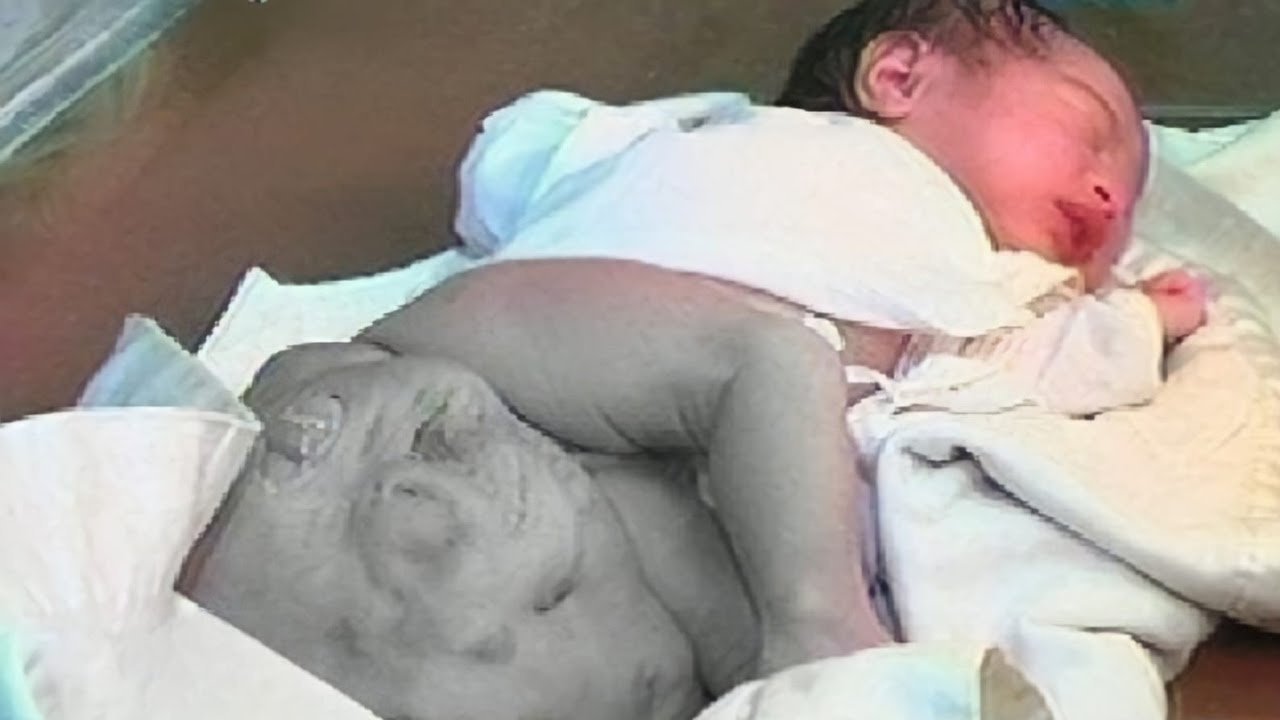
Doctors couldn’t stop crying when they realized how this baby was born, with the exception of the massive cyst. Harry Baron Edgley was born healthy. He’s undergone five operations in order to remove the tumor from his body. He’s now 15 weeks old and recuperating at home with his parents and siblings. A young boy was born with a gigantic cyst so large that it appeared as if he had two heads. He has made a miraculous recovery, according to doctors.
Harry Baron Edgley was born healthy, with the exception of a 13-centimeter cyst on the side of his neck, which he developed as a child. It was so huge that his worried mother, Ali Wellman Smith, age 20, initially believed her baby had been born with two heads because of the size of the cyst. Dr. Roberts was ultimately able to remove the tumor that was causing Harry’s back and neck difficulties after five operations. The 15-week-old has returned to his family in Corby, Northamptonshire, where he’s been since birth.
“As soon as I’d given birth to Harry, I closed my eyes in relief because I was so relieved that I’d managed to get him out,” Miss Wellman Smith recalled the moment. “I opened my eyes as they handed him over to me. I was stunned; I believed he’d been born with two heads. I had no idea what it was, whether it was cancer, a tumor, or something he’d have for the rest of his life, and it was quite frightening. I was overcome with love for him that I couldn’t care less about how it appeared. All I cared is that my kid was safe. I just consider myself really fortunate that the doctors were able to remove it. You’d have no idea what was there before,” she says of what was on Harry’s neck.
Doctors were originally afraid that Harry’s growth might be something more serious, but Miss Wellman Smith was relieved to learn that the cyst was simply aesthetic in nature and would go away on its own. As a child, Harry was born with lymphatic malformations, which are collections of fluid-filled sacs known as cysts, caused by defects in the lymphatic system responsible for draining fluid from the body’s tissues. The sacs, which can leak and cause the growths to grow in size, develop when the lymph vessel fails to perform properly during the first few weeks of pregnancy.
When the midwives noticed Harry’s bulge, they immediately activated a buzzer, which brought in around 30 doctors to the room to determine whether he was breathing. They examined the area around the growth and placed objects down his throat. After that, he was taken to the special care infant unit, and for approximately an hour and a half, I had no idea whether or not he was still alive. I was relieved when the doctors finally told us that Harry had a lymphatic malformation and that it was only a cosmetic issue.
After an ultrasound scan the following morning, the hospital released us and scheduled an outpatient visit for us for three weeks later to discuss his treatment. The doctors may have to cut into the growth, and Harry could have bled to death if they’d used forceps or performed a c-section,” says the mother. Miss Wellman Smith was informed at her son’s outpatient session that he might be able to benefit from injectable therapy to help reduce the size of the cyst. Miss Wellman Smith sought a second opinion from Mr. Cow, a consultant ear, nose, and throat surgeon at Birmingham Children’s Hospital, after being disappointed by the news that it would not be totally removed.
Mr. Cow’s view was accepted after our initial appointment. “I was worried that the cyst would never completely go, and I was scared that Harry would be bullied because of the size of the cyst,” Miss Wellman Smith explained. “I had the impression that his future looked grim and that Harry’s life was going to be a living hell. The growth was beginning to distort his back, and I was becoming increasingly concerned. When I got in touch with Mr. Cow, he was nothing short of outstanding. I was very relieved when the doctor told us that the cyst could be removed.”
After bringing Harry in for a scan, Harry had his first operation on the 1st of July, which was a success. In the words of Miss Wellman Smith, “When Harry went in for his procedure, it was the worst day of my life. Watching the doctors put him to sleep was heartbreaking. I could feel him slipping away, and I was a complete disaster. The surgery took five hours, and then I went to see him in the intensive care unit. It was strange at first to see him without the cyst on his spleen. The cyst was part of my baby, and that was how I’d carried him throughout his life. An unusual but amazing experience,” says the narrator.
Harry has undergone four further surgeries since his initial surgery. Despite the fact that it was a success, Miss Wellman Smith had to return to the hospital a couple more times because his cyst continued to enlarge. According to Miss Wellman Smith, however, “We’ve returned to our residence, and I couldn’t be more pleased. The entire staff at Birmingham Children’s Hospital has been outstanding, particularly Mr. Cow. Harry can get on with his life,” says the author.
“This is a really uncommon illness that can occur anywhere in the body,” said Mr. Kyle, a specialist ear, nose, and throat surgeon at Birmingham Children’s Hospital. “They can range in size from very small to quite enormous, and they can be composed of a large number of little cysts or a small number of massive cysts. It differs from child to child in terms of how you treat them. Dr. Simon McGurk, a specialist in children’s radiology, and I always meet the children together so that we can discuss with the parents the relative advantages of surgery versus injectable treatment. Dr. McGurk is also a member of our team.”
“Harry was fortunate in that his cyst was huge but did not restrict his airway, as was the case in Harry’s case. The operation went smoothly, and I’m happy with Harry’s performance. When you’re operating, it’s critical to avoid getting nervous, which might have an impact on things like smiling and making facial impressions. In order to allow for contractions, we always leave a small amount of extra skin, but eventually, you won’t be able to see anything at all.”
“The results for Harry have been outstanding. Congenital pancreatic cysts in infants and children are a rare source of abdominal tumors in this age group, and they provide distinct diagnostic and surgical complications. According to the available literature, there have only been 38 reported cases among children under the age of two. As a result, the correct diagnosis and the most effective treatment are still up in the air.”
“Prenatal diagnosis allows for early intervention and treatment, hence preventing illness progression. Congenital pancreatic cysts, on the other hand, are extremely rare because they’re generally asymptomatic and identified as a result of incidental abdominal enlargement. Furthermore, establishing a preoperative diagnosis can be challenging, especially when these cysts are large because they might be confused with other abdominal cysts, such as pancreatic pseudocysts or duplicated cysts of the pancreas.”
“Once a congenital pancreatic cyst has been diagnosed, the only option for therapy is surgical excision of the cyst. This, however, is not always possible due to time constraints. Depending on where the cyst is located, a variety of surgical approaches have been documented for the treatment of congenital pancreatic cysts.”
“This article recounts the successful surgery performed at our center on an infant who had a congenital pancreatic cyst. A review of the literature on this subject was also conducted. In most cases, congenital pancreatic cysts do not cause symptoms and are only discovered by chance. They might be large enough to be noticed or discovered by chance during the evaluation of other abdominal ailments. However, there have been reports of asymptomatic abdominal bulk, bloating, vomiting, and obstructive jaundice. Only periodic vomiting and an abdominal lump were observed in our patient. A huge abdominal mass upon birth, on the other hand, was not indicative of pancreatic cysts.”
“It’s extremely difficult to diagnose congenital pancreatic cysts prior to surgery, and the vast majority of documented instances are discovered during the surgical procedure. Prenatal diagnosis of congenital pancreatic cysts has only been documented in a few number of cases in scientific literature. The majority of cases are detected after 26 weeks, with reports of cases being diagnosed as early as 15 weeks. In our situation, an intra-abdominal cystic structure in the upper region of the abdomen was predicted by ultrasound at 33 weeks of pregnancy and was discovered later. As a result, the infant was brought to our facility shortly after birth for further evaluation.”
“Modern imaging methods frequently reveal well-defined monocular cysts on the retina, although this may be distinguished from other cystic lesions in the abdomen. Even when employing a combination of test results, clinical symptoms, and diagnostic imaging, it can be difficult to discriminate between the two conditions. When it comes to this element, abdominal ultrasonography is a quick and dependable test. However, it’s unable to pinpoint the exact location of the cyst’s origin. Therefore, abdominal computed tomography or CAT scans and magnetic resonance imaging (MRI) are more beneficial. When compared to CAT, MRI is more useful in determining the origin of the big cysts.”
“Both ultrasonography and computed tomography were successful in detecting a cyst in the abdomen in our patient. However, none of these tests were able to determine the source of the cyst. In the course of the operation, the final diagnosis of a congenital pancreatic cyst was made in our patient. We suspected the little portion of the head and tail of the pancreas as the source, which could be seen on a CAT scan but was missing prior to surgery retrospectively. Aside from that, we saw a minor increase in serum lipase, but this did not lead us to a conclusion about the cause. Thanks for reading.”