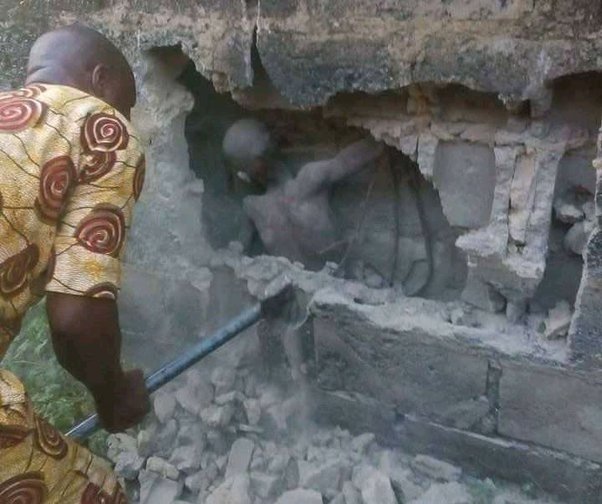
On that fateful day of December 9, 2016, the residents of Oduduwa area in Nigeria were going about their usual routines, unaware that their lives were about to be plunged into a state of shock and disbelief. The news of mystery cases dropping down their social media feeds had desensitized them to some extent, but this particular incident would prove to be unlike anything they had ever encountered before.
In the quiet town of Ondo, where the streets were lined with houses that had withstood the test of time, a remarkable discovery was made. Hidden within the walls of a seemingly ordinary compound, a twelve-year-old boy was found trapped in a tiny pocket hole. The compound had stood for over two decades, and it was baffling to imagine how such a young child could have ended up in such a perplexing predicament.
As the news spread like wildfire, the internet was abuzz with speculation and theories about the boy’s identity and the events leading up to his entrapment. Was this the result of a malevolent spiritual force, or was there a more mundane explanation behind this chilling discovery? The headlines of newspapers and social media platforms were filled with sensationalized tales, each more dramatic than the last, leaving the public hungry for answers.
Authorities and local residents worked tirelessly to unravel the enigma surrounding the boy in the wall. Detectives combed through the compound, seeking clues that could shed light on the baffling incident. Every nook and cranny was scrutinized, and witnesses were questioned to piece together the boy’s journey into that narrow, confined space.
As the days turned into weeks, the mystery deepened, and the community became increasingly obsessed with the boy’s story. Speculation and rumors ran rampant, with some suggesting that the boy was a victim of a wicked curse, while others hypothesized that he had stumbled upon a hidden passage leading to the pocket hole. Some even proposed that the boy possessed supernatural powers that allowed him to traverse walls.
But amidst the swirl of theories, one thing remained certain—the boy’s miraculous survival defied all odds. How had he managed to endure the darkness, isolation, and confinement for so long? It was a testament to the resilience of the human spirit, a testament that captivated the hearts of millions around the world.
News outlets from far and wide sent their reporters to cover the extraordinary tale, turning the boy in the wall into a global sensation. The story touched a nerve with people from all walks of life, evoking feelings of compassion, fear, and wonder. Prayers and well-wishes poured in from strangers who had never even set foot in Ondo, each hoping for the boy’s safe recovery and the revelation of the truth behind his mysterious entrapment.
Amidst the drama and chaos, the boy remained silent, leaving the world yearning for his voice and eager to hear his side of the astonishing tale. The walls that had confined him now seemed to hold the answers to questions that perplexed both the authorities and the curious onlookers.
Months passed, and the boy’s story slowly faded from the headlines. But the mystery of the boy in the wall lived on in the memories of those who had been touched by his inexplicable plight. Though time may have dulled the fervor of curiosity, the tale of the trapped boy remained etched in the annals of local lore, a reminder of the inexplicable wonders that life occasionally presents.
In the end, the boy in the wall became more than just a sensational news story. He became a symbol of resilience and hope, a testament to the mysteries that lie hidden within the walls of our own lives. And as the world moved on, the enigma of the boy’s confinement lingered, a puzzle that may never be fully solved, leaving behind a trail of wonder and awe that would endure for generations to come.